
Read McCreary County Property Tax Records
Three offices split the work. The McCreary PVA qPublic record holds the assessment and classification fields. The sheriff's services page links current land-tax access, and the County Clerk plus the statewide delinquent-tax route matter after an unpaid bill becomes a certificate.
| Field | What It Shows | Where |
|---|---|---|
| Map number and account/PID | Parcel identifiers joining the assessment to maps and other records | PVA qPublic |
| Land, improvement, and total values | Assessment components for the stated year | PVA qPublic |
| Class, district, and homestead flag | Classification and exemption context carried on the parcel card | PVA qPublic |
| Current bill and receipt status | Year, charge, payment, or amount due as displayed | Sheriff tax route |
| Certificate and sale status | Delinquency, clerk administration, notice, and sale-stage facts | County Clerk / DTax / annual notice |
Kentucky assesses property at 100 percent of fair cash value. An assessment is not an appraisal, though. It is not an offer or the last sale price either. The final tax depends on that year's rates, classifications, districts, and exemptions. Keep four figures apart. Land value, improvement value, total assessment, and recorded sale consideration each answer a different question. qPublic numbers belong to an assessment year. Deed consideration belongs to a recorded transaction. The amount due belongs to one bill. Tax district and class matter too. Similarly valued parcels can carry different bill contexts. So label every figure with its source and year.
Search McCreary qPublic Tax Fields
Search qPublic by owner, address, or parcel number. Keep the whole map number intact, leading zeroes and decimal suffixes included. A result can show the owner and mailing address, location, tax district, homestead status, class, description, acreage, deed reference, assessment values, and a View Map link. The official PVA search entry opens the assessment side. It is not the bill-payment system.
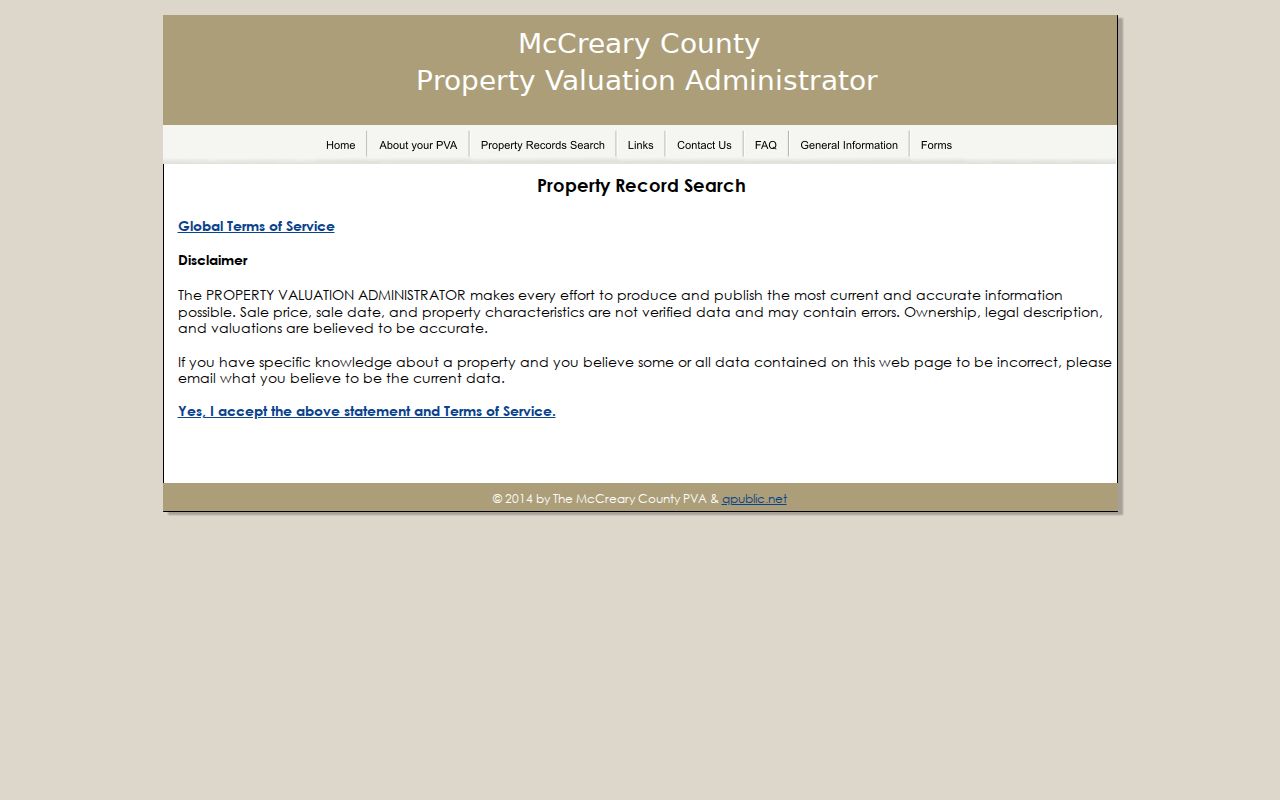
Copy the map and account identifiers first. Then every office sees the same parcel. A sample McCreary parcel report filed with the Kentucky Public Service Commission carries a February 25, 2022 upload timestamp. That sample shows which fields exist. It does not give today's value or owner. Save the live result's own timestamp and weigh it against the assessment year. If a recent deed and the roll disagree, let the clerk's instrument settle the transfer while the PVA explains its update timing.
Follow a McCreary County Tax Bill
Current collection and delinquent-certificate research are two different stages. The sheriff collects the county's current property taxes. The County Clerk takes the certificate and recording side. The sheriff's live tax page publishes no stable search fields, so confirm its current controls and coverage with the office.
- Identify the parcel in qPublic and copy the map/account number, district, classification, and assessment year.
- Open the sheriff's linked land-tax route and match the owner, property address, year, and parcel identifier.
- Record current amount, payment or receipt status, and the as-of date; contact the sheriff when the endpoint fails.
- For delinquency, check the County Clerk and Kentucky DTax, then read the current annual sale notice.
- Assessed value
- The PVA's taxable valuation for the stated assessment year.
- Rate or levy
- The annual rate applied by the relevant taxing authority or district.
- Homestead exemption
- Qualifying relief administered through the PVA and reflected in assessment context.
- Tax lien
- A legal claim arising from unpaid property tax; delinquency can become a certificate.
From Unpaid Bill to Delinquent Certificate
The Kentucky Department of Revenue collection guide walks through the general path: delinquency, certificate, notice, publication, and sale. The current notice sets the deadlines.
DTax serves third-party purchaser and delinquent-bill research. It is not the payoff authority. Statewide results can show bill number, year and type, owner, property address, map ID, amount, and date. Payments, exclusions, and later charges shift the balance, so confirm amount and status with the McCreary County Clerk.
Preserve the advertised owner exactly as printed. That name is not a current-title conclusion. A certificate can reflect an older roll. A deed, court order, redemption, exclusion, or payment changes the practical picture. For a completed sale, read the certificate, the annual notice, the court file, and any later recorded deed.
Note: Record the balance date and source; a tax amount displayed yesterday may not be the payoff amount accepted today.
What the 2025 Sale Notice Teaches
McCreary's official 2025 notice placed public inspection in Room 139 at 1 North Main Street, set an August 15 registration deadline, and scheduled the sale for August 26. Payment and exclusion details appeared there too. The notice works well as a model. None of it carries into 2026.
For the current year, record the inspection location, list date, registration deadline, sale date and time, payment methods, excluded bills, and clerk contact. Compare the advertised map ID and owner against qPublic. Do not assume the PVA roll reflects a later transaction. Rolls update on their own schedule.
Rates Are Annual, Not Permanent
A September 2025 local report put the compensating county rate at 8.3 cents per $100. That was down from 8.5. Assessments had risen. That is dated context. It is not a reusable rate. It is not a full bill calculation either. A parcel may also sit inside districts that levy their own taxes. For the applicable year, use the current Kentucky property-tax resources. Use the parcel's bill, and ask the responsible local office. Save the rate sheet and the bill together. A later reader can then tell a county rate from the parcel's total tax.
Check Classification and Exemptions with the PVA
The McCreary County PVA office, led by Dwight A. Ross, handles real-property assessment. It administers homestead and disability exemptions, and hears the first stage of appeals. Kentucky also allows agricultural use-value treatment under qualifying rules. Treat the homestead flag or class on a parcel card as a starting fact. It is not a decision about eligibility for a coming year.
Reach the PVA at 606-376-2514, PO Box 609, Courthouse Suite 114, Whitley City. Ask about the current application, eligibility rules, filing timing, and documentation. Also ask about the year an approved change takes effect. Never assume qualification from age, acreage, disability, or a prior owner's status.
Contest a McCreary County Assessment
Kentucky sets the assessment date at January 1. The law also calls for a physical inspection of every parcel at least once every four years. Values can move each year in between. To challenge an assessment in McCreary County, start with a conference at the PVA office. From there, a local board appeal must be filed within the deadline tied to the inspection period. Further review runs through the Kentucky Board of Tax Appeals and, if needed, the courts.
Evidence carries the appeal. Gather photographs and measurements of the property's physical features, comparable sales or listings, construction costs, insurance records, and income information where it applies. Include the prior assessment and the challenged year's notice. Check the current conference and board dates yourself. An older calendar can mislead.
Match like property to like property, and explain any adjustments rather than handing over a bare list of prices. Keep the parcel's class, acreage, improvements, condition, location, and assessment year in plain view. Bring copies to the PVA conference and keep proof of any later filing. One caution applies. An appeal settles valuation questions only. A wrong owner, acreage, or legal boundary may need a separate correction supported by deed records or a survey.
Appeal window. The McCreary PVA conference comes first, and the local board filing deadline follows the statutory inspection calendar. Verify the current year's dates immediately after receiving notice.
A valuation appeal argues about assessment evidence. It cannot rewrite a deed, move a boundary, or transfer ownership. For recorded ownership, work through deed records. For GIS reference work, use parcel maps.
After any conference or appeal ends, save the written decision. Then hold it beside the next qPublic entry and the tax bill that follows. Confirm which assessment year changed. Note whether land and improvements were adjusted separately. Note whether an exemption or classification was fixed too. If the bill ignores the decision, contact the PVA and the collecting office with the parcel number, decision date, and bill year in hand. Never assume one office updated every system on its own. A dated paper trail pinpoints whatever discrepancy survives.